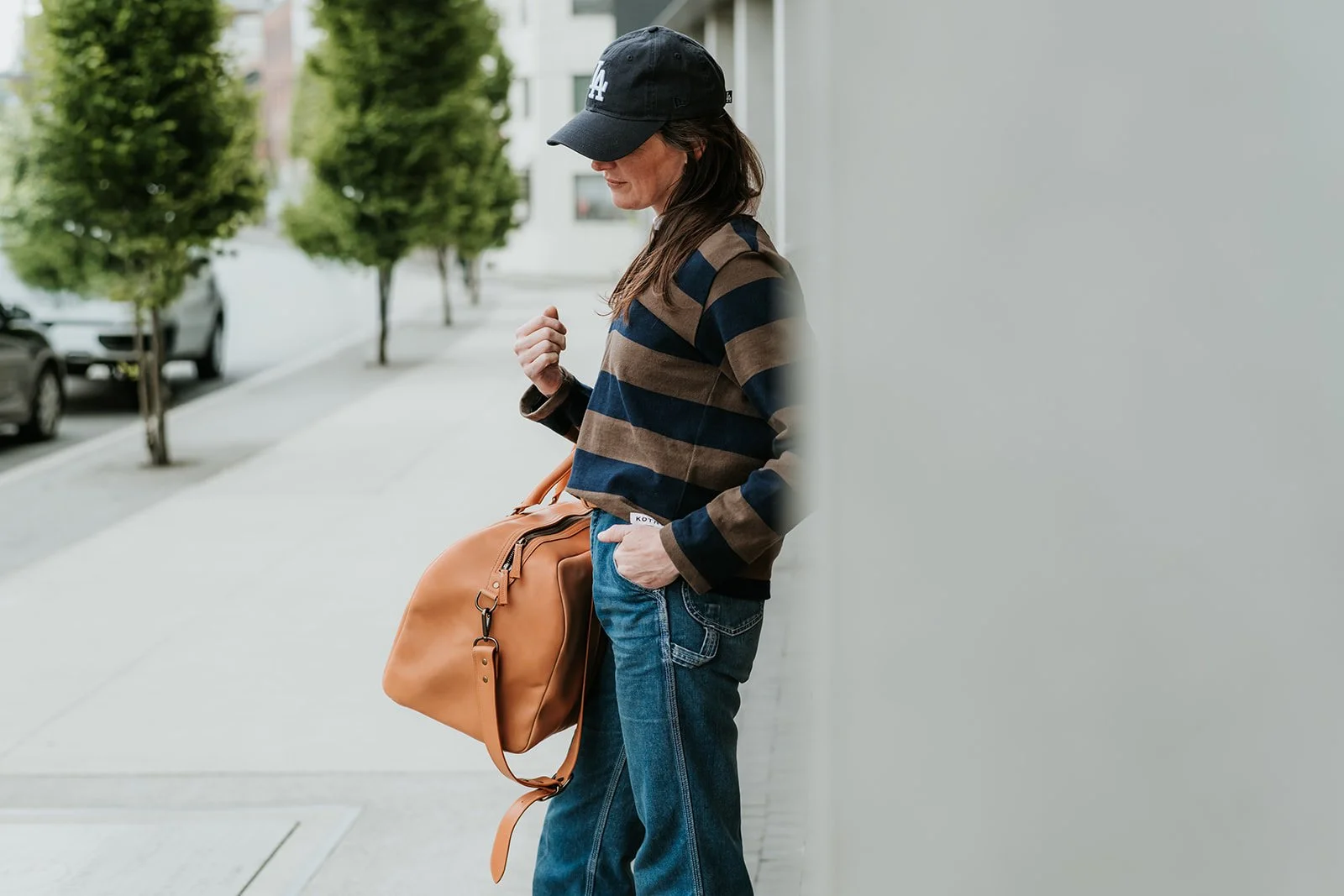
Archive partnership for the Chabanel Collection
Interview for Archive
Archive is a new company with roots in the footwear foundation of Love Jules Leather. That earlier chapter helped establish a language of craft and storytelling that still matters, while Archive brings a more defined framework to how the work moves forward.
The result is a brand shaped by greater focus. Tighter production, more deliberate making partnerships, and a clearer standard for what enters the collection. The name Archive reflects that intention, pieces worth choosing carefully, using fully, and keeping because they continue to prove themselves over time.
Corinne Bourget makes things by hand in Montreal. She trained in Melbourne, built Atelier HOTELMOTEL in 2018, and has spent the years since proving that handmade sneakers are possible and that making things well takes as long as it takes.
She made the bags and accessories in Archive Volumes 01, & 02, and the upcoming Chabanel Collection. We asked her some questions.
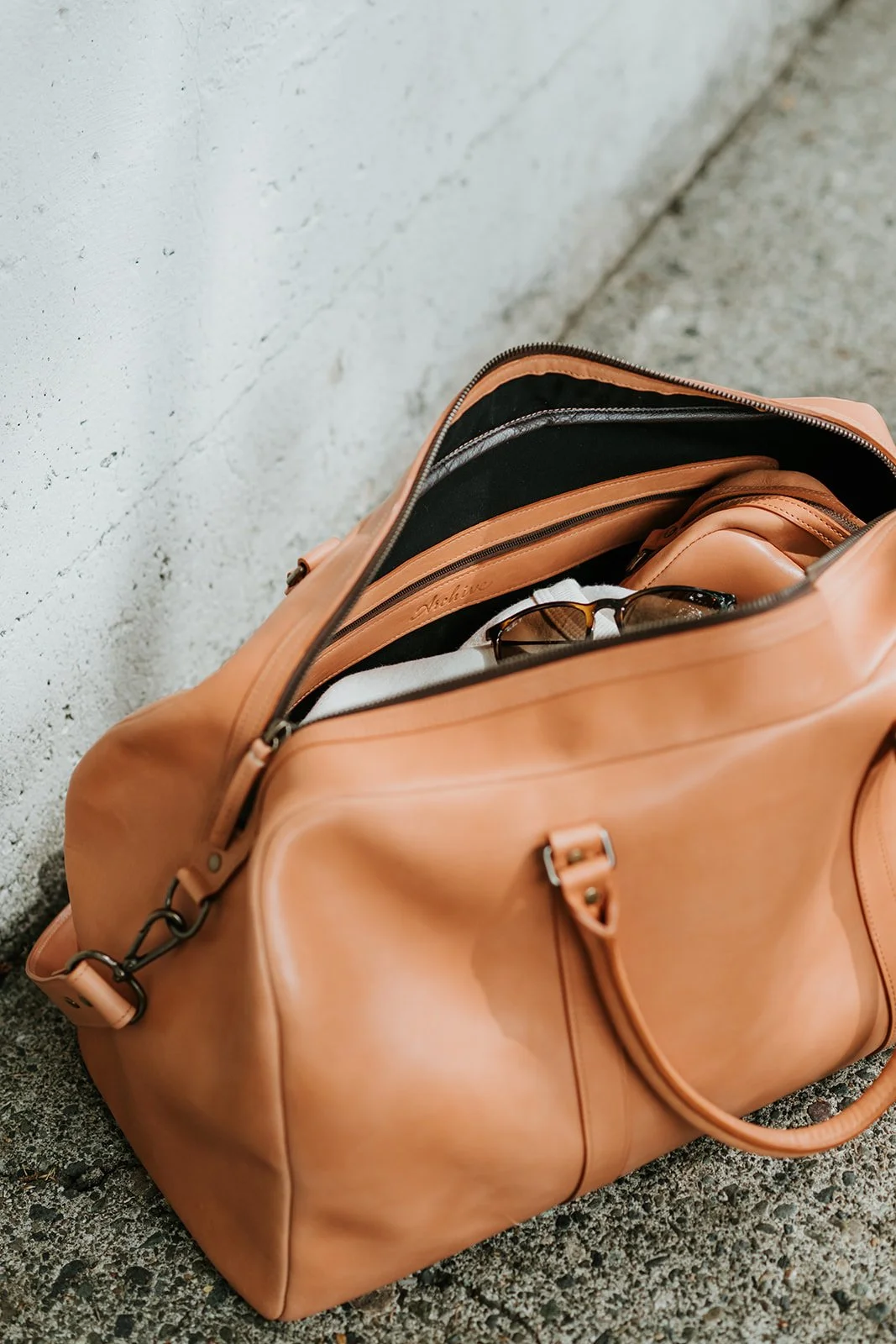
The Chabanel weekender bag - made by Corinne for Archive
You went to Melbourne to learn shoemaking because there were no schools left in Canada. What was that experience like, and what did you bring back with you?
It was so much fun as well as a great learning experience. Melbourne is the Australian Montreal. I was with two shoemakers; Theo Hassett and James Roberts, they had their studio within a coffee shop called Captains of Industry. There were two other studios within the shop: a tailor and a barber. Everything had a “Mad man” vibe. Robert and Hassett were making made-to-measure shoes and boots using vintage wood lasts and kangaroo leather. They were using very traditional shoemaking techniques, they only had a sewing machine for the uppers. I was there to help them develop leather accessories while they taught me how to make my first pair of boots, from the patterns to the finish pair. I improved significantly (not without sweat) my skill with the skiving blade since they did all their skiving by hand. Even the thickest veg-tan leather pieces. I must have spent a whole day practising just the sharpening part. They had a waiting list of 6 months for a pair of custom shoes and once they start working on one pair, they would take the measurement, design the patterns, make a mockup for try-on then make the final pair. It was roughly a two week process. It was a great exchange of our own expertise while all of us share the same high appreciation for leather. I’ve learned all the shoemaking terms in English while my accessories and leather making slang is in French.
“They were using very traditional shoemaking techniques, they only had a sewing machine for the uppers.”
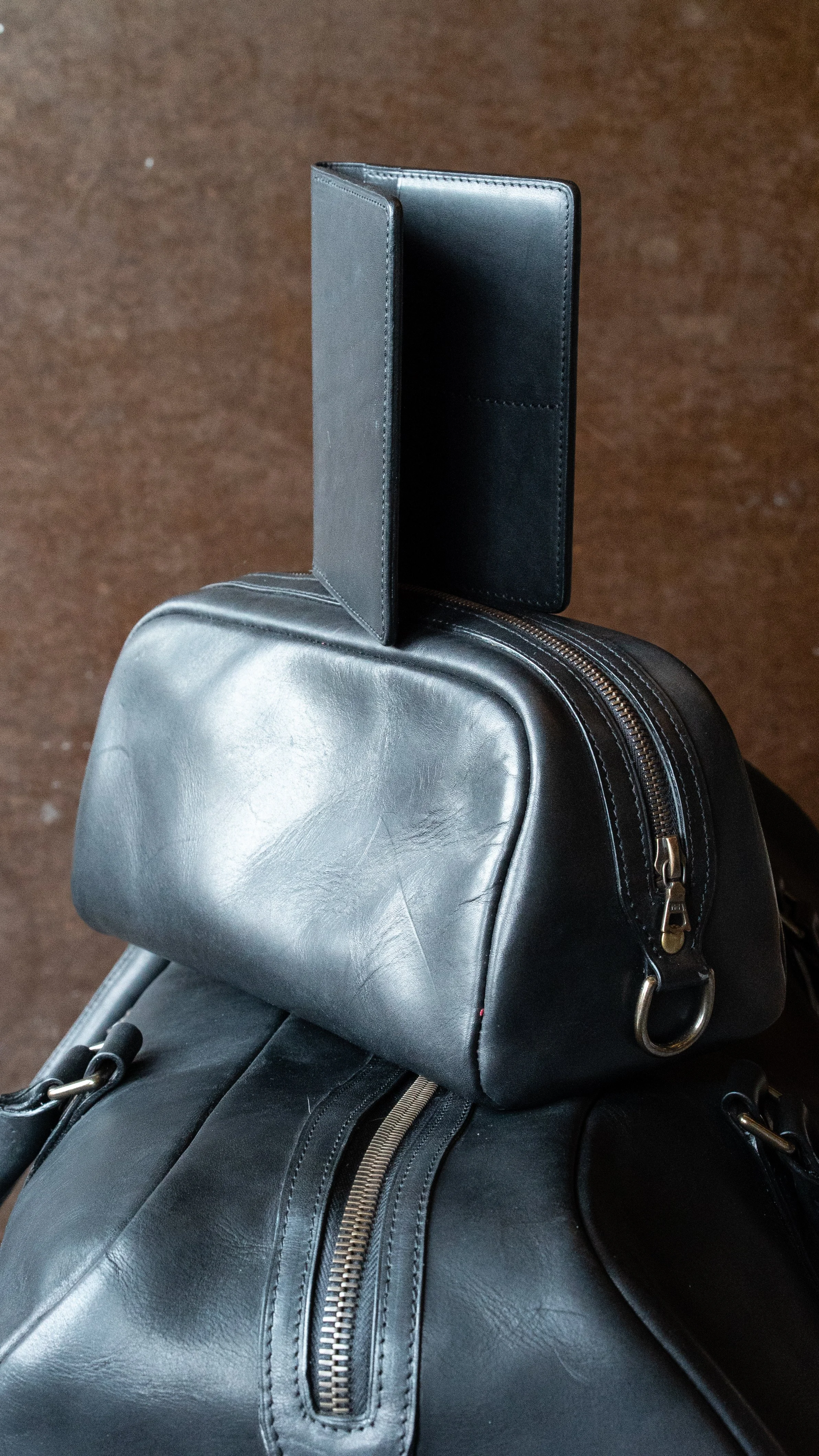
The Chabanel Collection - Passport wallet, Dopp kit and weekender bag in Horween Essex leather
You started HOTELMOTEL in 2018 specifically to preserve shoemaking knowledge in Montreal. What did that look like in practice in the early days?
We were a team of three at the beginning. I had a small studio before that where I made only leather goods. We decided to make sneakers because no one was making them by hand at the time. We got instant traction from the media because of it. People couldn’t believe it was possible to make sneakers by hand. They were used to see shoemakers making very traditional leather shoes or boots, but sneakers: never. That’s exactly what we wanted: show the process and reconnect the customer to the real work behind the shoe. Sneakers are so common that people think they come from a mold rolling around in an overseas factory. It’s not, even over there, real people work on the shoes. They do have more machines than me, but real hands touch the materials. We did a few fairs and people didn’t believe us when we said we were making the sneakers by hand, I heard them turn around and say: “I bet they only lace the shoes.” So we really focus on being transparent on our socials, and bring deconstructed pairs to future fairs and open the studio for visitors.
Montreal had a serious manufacturing history before the 1980s. Do you feel any connection to that earlier era in your work, or does it feel like you are building something from scratch?
The industry is disconnected, only a few manufactures are still operational like Anfibio, Pajar, Boulet, Royer. La Canadienne just closed their warehouse to produce elsewhere. You also have the costume industry like Cirque du Soleil, but they are also slowing down. The shoemakers are very rare, mostly self-taught independents across Canada, but social media helped me get in touch with them and that’s how I started building my circle. Even when I was writing HOTELMOTEL’s business plan, it felt like a desert and the grantors and bankers were questioning me about why I would start a business in a dying industry. The pandemic actually changed that narrative when they realized that our country was too dependent on imported goods.
Walk us through your studio. What does a typical day at the bench look like?
I don’t have a typical day, because I do so many many things (teaching, producing leather goods, prototyping, sales, accounting, marketing, etc…) and I often fall behind in some categories. If I focus on when I spend a day at the bench… I always walk to the studio with my dog Happy, a dalmatian/border collie mix who needs to spend his energy before his hard day at work. I usually make coffee first and go through emails and fill up orders. Then I put on a podcast and get in my head for the rest of the day while Happy goes back and forth between getting rubs and chilling on the couch. My studio is about 1000 sf shared with another maker, Marie Jo Dorval (Kid’s Stuff) who makes beautiful and playful clothes for kids. Happy is obsessed with her. My space has a large window viewing the train tracks and some beautiful sunsets. I have a big cutting table, a few sewing machines, a skiver, a hot-stamping machine and a finisher. The wall has shelving up to the ceiling holding all the soles and components I need for shoemaking. I can get a bit messy when I’m deep into production. I love production, finding ways to optimize the steps while keeping the same high quality.
When you are evaluating a piece of leather before you cut into it, what are you actually looking for?
I always look for defects (cracks, insect bites, scars, stains,...). That's the first step. Then the stretching, a hide has different stretching spots in different ways too depending on the body part (neck, belly, …) After that, I will put on the pattern pieces to see if everything fits while avoiding what I don’t want. For bigger bags, I will look at the grain, we don’t want a big disparity between the grain from a part that is next to another (the front and the flap for example). It's a bit like the continuity of a pattern on a fabric. It’s especially important with exotic leather (or exotic embossed leather). Finally, I will assess the thickness, if I need to split or reinforce it.
The bags and accessories in the Chabanel Collection went through a lot of iteration before they were ready. What was that process like from your side?
On my side, it didn’t feel like that much, it felt like teaching. I’m specialized in leather goods, it’s normal to do some back and forth to understand what the collaborators have in mind, versus the possibilities and limits of the leather and certain types of assembly. I did leather goods development for other people from different types of industries (fashion, industrial design, corporate, restaurants, hotels…). It's totally normal to go through one or more prototypes and tests before getting to the final product. And every time we make that product again, we can always improve different aspects. It’s also very important to test the prototype before starting production. The functionality and comfort are as important as aesthetics. It was also our first time working together, so we are building a way to work and understand each other. It's a real process with a learning curve and it’s all very human.
“The functionality and comfort are as important as aesthetics.”
What does a piece have to do, functionally, before you are satisfied with it?
It has to do what it’s meant to do first, be ergonomic, comfy, not too heavy. It has to be built to last. It has to have enough space, enough compartments to carry what it’s supposed to carry. And then it needs a good aesthetic.
You describe your work as being made "with tenderness and meticulousness." Most makers would just say precision. What does the tenderness part mean to you?
A hide is from an animal and I respect it. I don’t want to scratch or stain it in the process and waste any of it. It’s about cutting your nails before you touch the leather. Making sure your hands are clean. Double check the table is clean. Keep the leather, the unfishing pieces and the finished products away from sun exposure and dust. This attention goes beyond precision.
What is something about how leather goods are made that most people have no idea about?
First, the finishing is a step that is very time consuming, it’s a little like finishing wood furniture, there are a few layers of dye with sanding in between each layer. Second, there are a lot of inner components, reinforcement materials that give rigidity or avoid stretching or to strengthen the anchors of a handle or a strap. A bag with the right amount of reinforcement and good finish will be more durable.
I think leather craft is a middle ground between fabric and wood, we use needles, thread, sewing machines, as much as hammers and sanding machines.
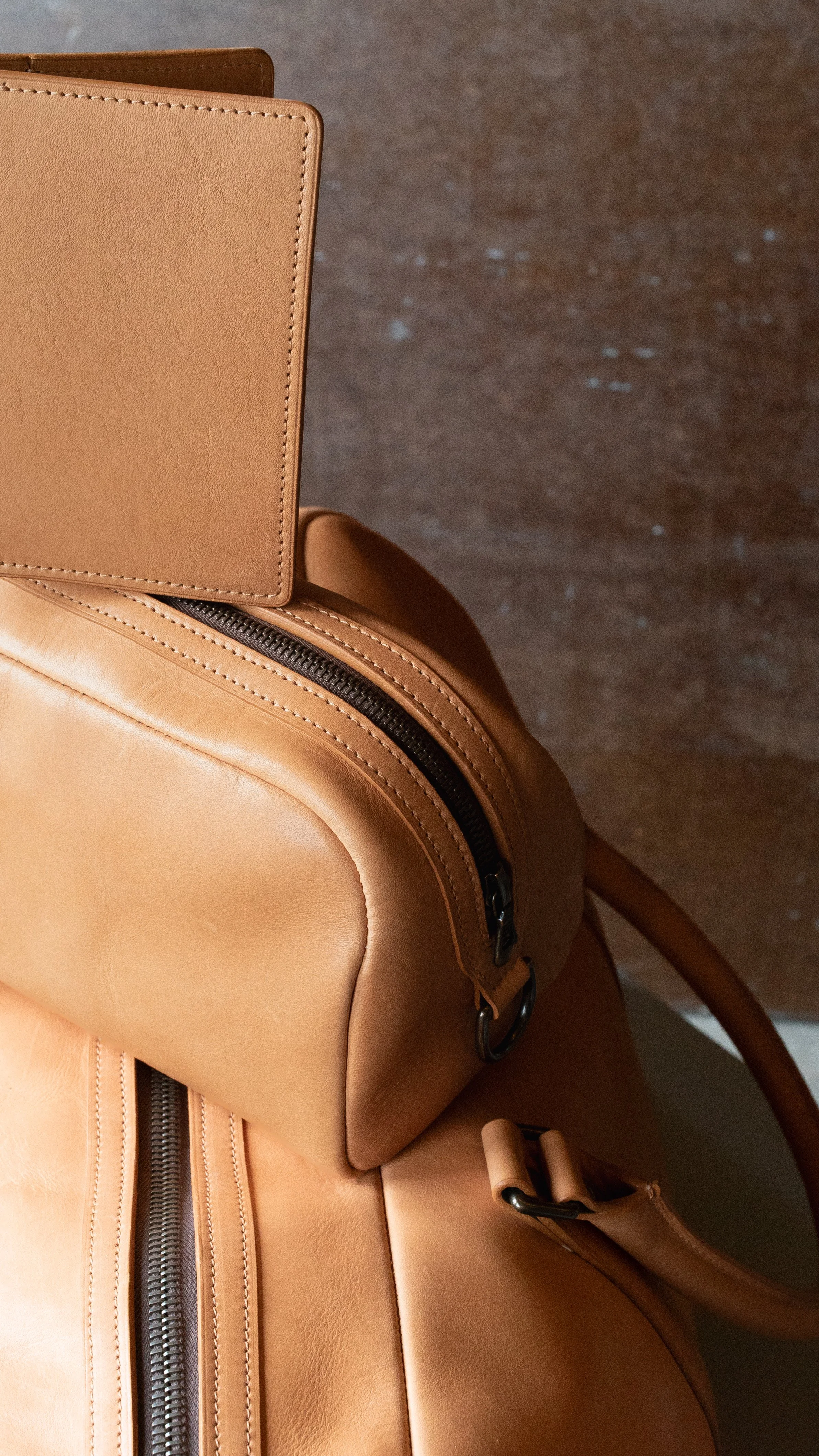
The Chabanel Collection - Passport wallet, Dopp kit and weekender bag in Horween Essex leather
What does it mean to you to be making things in Canada at this particular moment?
That meaning has changed a few times for me since 2018, but it definitely feels like going against the grain. From the feeling of pride to be part of a tiny tiny community of makers who value durability and quality materials, to showing people that making things well takes time and mastery. The world is burning and why am I even making stuff in my studio that only a small portion of people can afford? If we don’t keep doing things here, we will lose the know-how as a nation. I teach the trade to motivated students while trying to be honest about how hard it is to live from it in Canada.
“I’m really proud of what I do and I’m so privileged to be making high quality things here.”
For early access to Archive releases, including the Chabanel Collection, sign up here.